The Brutal Reality of Building in the North
Driving through North Queensland or the Top End after a big blow is a humbling experience. You see roofs peeled back like sardine cans and timber trusses snapped like dry kindling. It makes you realize pretty fast that the Australian building standards for Regions C and D aren't just bureaucratic red tape. They're written in the wreckage of houses that couldn't cut it. When the barometric pressure drops and the sky turns that weird shade of bruised purple, you want to know that the skeleton of your home is up to the task.
We've worked with plenty of owner-builders from Broome down to Bundaberg. They all ask the same thing. Is steel actually better when a Category 4 cyclone decides to take a swipe at the coast? The short answer is yes. But it's not just about the metal itself. It's about how that metal is engineered to behave as a single, unified system under extreme stress. Steel doesn't just sit there. it fights back. Because steel has a much higher strength-to-weight ratio than traditional timber, we can achieve spans and bracing capacities that would require massive, chunky hardwood beams in a stick-build. And frankly, nobody wants to lug 200kg beams around a site in 95 percent humidity if they can help it.
Engineering for the Big Blow
Standard kit homes for sunny suburbs in Sydney are one thing. Engineering a kit home for a cyclone zone is a different beast entirely. We use BlueScope TRUECORE steel for a reason. It's consistent. Every piece of C-section and batten has a predictable yield strength. When an engineer calculates the uplift on a roof during a wind event, they need to know exactly when a member will flex and when it will fail. With timber, you're dealing with knots, grain variations, and the risk that a piece of wood sat in the rain too long and started to warp before it was even nailed in.
In a high-wind area, the danger isn't just the wind pushing the house over. It's the suction. The wind screams over the roof and tries to rip the whole structure out of the ground. It's called uplift. To combat this, kit homes designed for these areas use a crazy amount of heavy-duty tie-downs. We're talking rods that run from the top plate all the way down into the concrete slab or the footings. When you're bolting a steel frame together, you're creating a continuous path for that energy to travel. The roof is bolted to the trusses, the trusses are bolted to the wall frames, and the frames are bolted to the earth. It's one solid cage. Timber often relies on hoop iron and nails. Nails pull out. Bolts don't.
The Precision Factor
Ever tried to hang a door in a house where the frame has warped 15mm because of a tropical wet season? It's a nightmare. Steel frames don't soak up moisture. This is a massive win for owner-builders who might take a bit longer to get the cladding on. You can leave a TRUECORE frame standing in the rain while you wait for the plumber to show up, and it won't move a millimetre. It stays straight, true, and square. This precision actually helps during a storm too. If the frame stays perfectly aligned, the windows and doors stay sealed. Once a seal breaks and the wind gets inside the house, the internal pressure doubles, and that's usually when the roof flies off. Keeping the 'envelope' tight is your best defense.
The Termite Side-Effect
If you live in a cyclone region, you're probably also living in a high-intensity termite zone. Those little white ants can hollow out a 4x2 stud before you've even finished your morning coffee. While we're talking about structural integrity during weather events, we have to mention that a termite-damaged frame is a compromised frame. If a cyclone hits a house that has been quietly eaten from the inside out, the engineering goes out the window. Steel frames are 100 percent termite proof. No chemicals, no sprays, just metal that isn't on the menu. It's one less thing to worry about when the wind starts picking up speed.
Safety is a big deal. For some reason, people think steel frames might be more dangerous in a lightning storm. It's actually the opposite. A steel-framed house is essentially a Faraday cage. If it gets hit, the energy is conducted through the frame and safely into the ground. It doesn't ignite like old, dry pine. When you combine that with the fact that these kits are non-combustible, you've got a much better chance of staying safe if things go pear-shaped.
Tips for the Owner Builder on the Tools
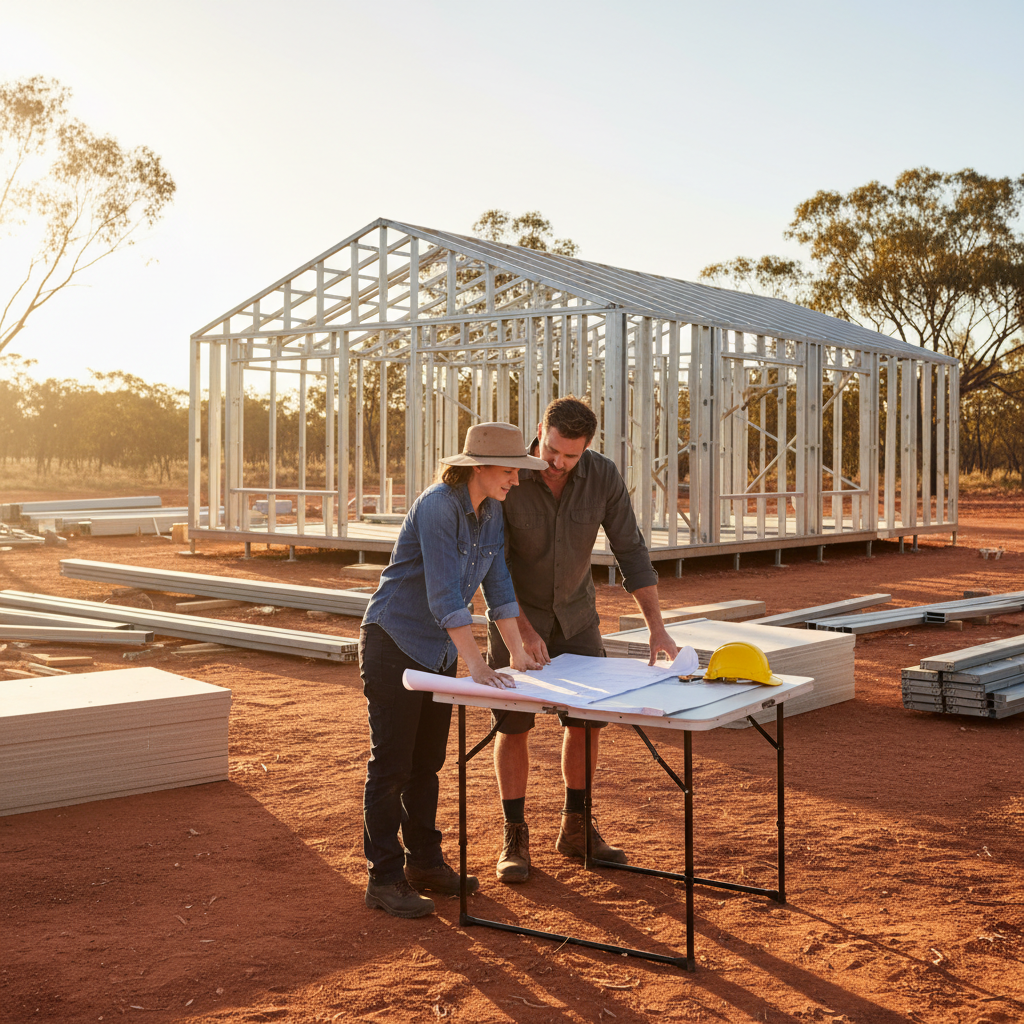
If you're tackling a kit build in a windy spot, there are a few things I've learned the hard way. First off, don't skimp on the screws. Our kits come with specific fasteners for a reason. Don't go buying cheap knock-offs from the local hardware shop because they were five bucks cheaper. Use what's supplied. The coating on those screws is designed to play nice with the galvanized coating on the steel. Mix them up, and you'll get electrolysis, which leads to rust. Fast.
Second, pay attention to your bracing. The engineering plans will show you exactly where the K-bracing or the strap bracing needs to go. Don't think you can move a brace because it's in the way of a power point. That brace is what stops your house from becoming a parallelogram when a 200km/h gust hits the gable end. If you're unsure, ask. Most kit providers would rather spend ten minutes on the phone explaining a diagram than have you mess up the structural integrity of the build.
Third, get your site clean. In a cyclone zone, anything left lying around becomes a missile. This applies to the construction phase too. If there's a weather warning, don't just leave your packs of cladding sitting on the grass. Strap them down or move them inside the frame if the floor is down. I've seen a sheet of corrugated iron slice through a car door like it was butter.
The Myth of the 'Rattly' House
I hear this a lot. People reckon steel frames are noisy or they clank in the wind. That's old-school thinking from the 70s. Modern steel kits are engineered with thermal breaks and high-quality insulation. When they're screwed together properly, they're dead quiet. Plus, steel doesn't 'creep' like timber. You won't get those loud cracks and pops in the middle of the night that sound like someone is breaking into your lounge room. It's a stable, predictable material. And when the wind is really howling outside, you'll be glad for that stability. There's a peace of mind that comes with knowing your house isn't just held together by friction and hope.
Building your own place is a huge undertaking. Doing it in a region where the weather is trying to kill your progress every six months is even harder. But by choosing a frame material that's been specifically tested for Australian conditions, you're giving yourself a massive head start. You're building something that will still be standing when the sun comes out the next day, which is the only metric that really matters in the end.