Walk into a twenty-year-old timber-framed house in the middle of a dry February in Wagga Wagga and you'll hear it. The house groans. You'll see the evidence too. There's that hairline crack running from the corner of the master bedroom door, or the way the pantry door sticks every time the humidity spikes. That's not just the house 'settling' as the old blokes used to say. It's the skeleton of the building literally changing shape as the moisture leaves the wood. For a kit home owner-builder, this is the kind of headache you can completely avoid if you understand the metallurgy of what's behind your plasterboard.
The Myth of the Straight Stud
Timber is a biological product. It's thirsty. Even the high-quality MGP10 stuff you get from the local yard has a moisture content. When that timber gets delivered to your site and sits in the Queensland sun, it starts to lose that water. As it dries, it shrinks, bows, and twists. If you've already nailed your gyprock to it, guess what? The plaster has to go somewhere. Usually, it cracks or the nails start popping out like little mushrooms under your paintwork. It drives people mad. Because steel is an alloy, it doesn't give a toss about humidity. It's dimensionally stable. A 2400mm wall stud made from BlueScope TRUECORE steel stays exactly 2400mm whether it's a soaking wet winter in the Otways or a blistering afternoon in Alice Springs.
Precision Engineering on the Slab
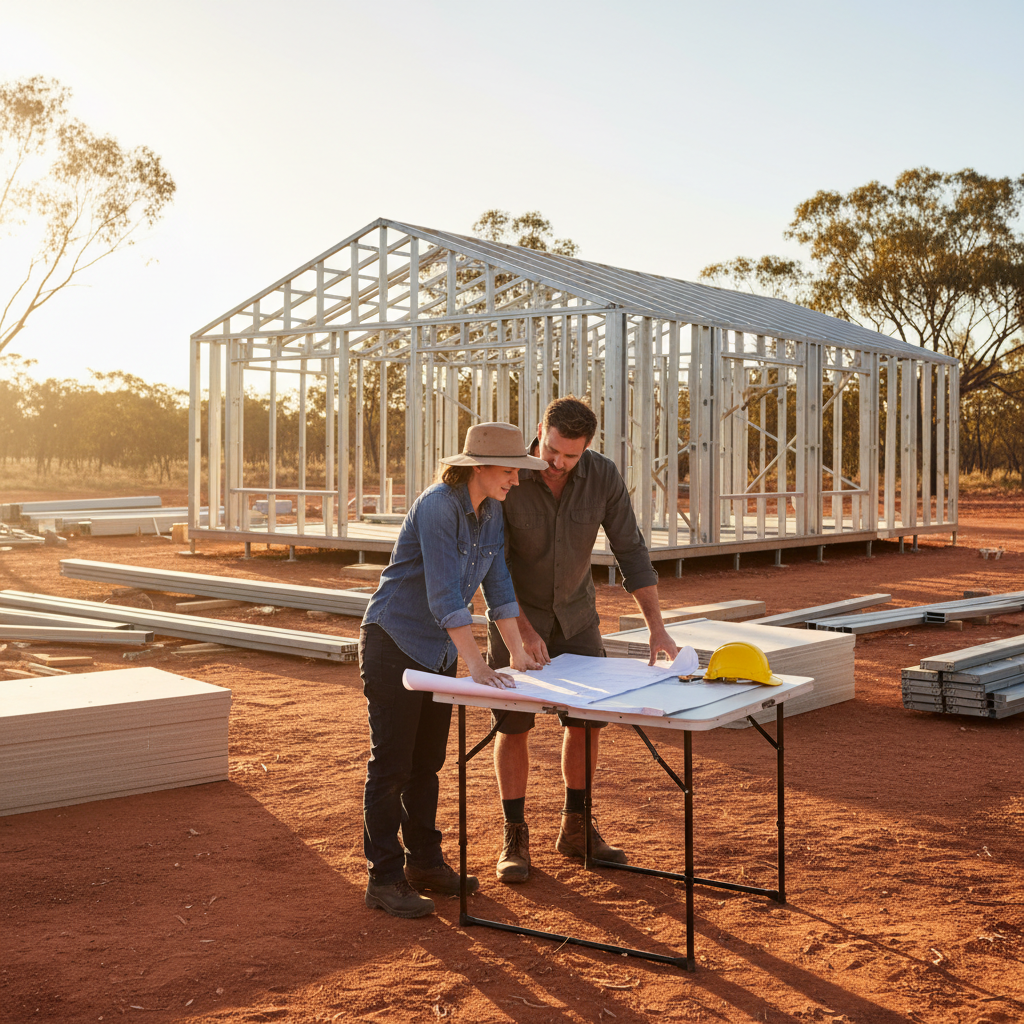
When you're out there on the slab on a Saturday morning, trying to get your first wall sections up, you want things to line up. We've all seen the alternative. You spend half the day with a plane or a power saw shaving down a 'proud' timber stud because it's warped like a banana since it left the mill. It's a waste of time. Steel frames are roll-formed to the millimetre. This means your corners are actually square. Your walls are actually plumb. When you go to install your windows and doors, they fit the openings because the openings haven't moved an inch. And trust me, when you're fitting out a kitchen and your overhead cupboards sit perfectly flush against a dead-straight steel-framed wall, you'll be glad you didn't go the stick-build route.
I remember a bloke up in Gympie who was adamant about using timber for his kit. Six months after he finished, the summer rains hit. The moisture uptake in his floor joists was so significant he couldn't get his sliding back door open. He had to take a plane to the bottom of a brand new door just to get out to his deck. That's the reality of 'movement' that people don't talk about enough in the brochures. Steel doesn't have those tantrums.
Thermal Expansion vs. Moisture Shrinkage
Now, some people will tell you that steel moves too because of thermal expansion. Sure, physics is physics. But there's a massive difference between how a steel frame expands and how timber shrinks. Steel expansion is predictable and uniform across the whole structure. Modern building techniques, like the way we use specific brackets and fixing methods according to AS 4100, account for this. It's a tiny, microscopic shift that doesn't pull the guts out of your joins. Timber shrinkage is erratic. One stud might twist left while the one next to it bows right. That's where the structural damage starts. Plus, with the insulation blankets and cladding systems we include in our kits, the steel frame is tucked away in a controlled environment anyway. It's not sitting out in the direct sun absorbing heat once the house is closed in.
Termites Don't Eat Steel
Actually, let's talk about the silent killers. Termites. In most parts of Australia, it's not a matter of if, but when. If a termite gets into a timber frame, they'll eat the structural integrity of your home while you're watching the footy. They don't touch steel. Using TRUECORE steel isn't just about straight walls; it's about peace of mind. You still need your ground-level barriers for your skirting boards and door frames, but the skeleton of your house is bulletproof. You aren't going to wake up one morning to find your roof sagging because the subterranean locals had a feast on your rafters. It's one less thing to worry about when you're managing your own build.
Working with the Material
New owner-builders often get nervous about steel because they think they need a welder or a master blacksmith to put it together. That's rubbish. You need a tek-gun and some snips. The frames arrive pre-punched with service holes. This is a massive win for your sparky and plumber. They aren't spending three days drilling holes through thick timber studs. They just pull their cables and pipes through the existing grommets. It's faster, cleaner, and it keeps the trades happy. Happy trades usually mean a better job. And because steel is lighter than timber, you aren't going to blow your back out trying to stand up a wall section with a few mates. You can literally carry most wall frames by yourself if you've had a decent breakfast.
One tip for when you're screwing off your cladding. Don't over-drive the screws. People used to timber tend to lean into the drill too hard. Let the screw do the work. The self-drilling tips on modern fasteners are designed to bite into the steel easily. Once you find the rhythm, you'll fly through it. It's actually quite satisfying. You get that solid 'crack' when it seats, and you know that screw isn't going to wiggle loose over the next thirty years.
The Straight Edge Test
Next time you're at a mate's place, run your hand along a long hallway wall. If you see shadows or ripples, that's the timber frame underneath doing its own thing. In a steel-framed kit home, those walls stay flat. This matters most in wet areas. If your bathroom wall bows even five millimetres, your tiles can crack or the grout will start falling out. Waterproofing membranes can only stretch so far. By starting with a frame that is dimensionally stable, you are protecting every other trade that comes after you. The tiler will thank you. The cabinet maker will love you. And the painter won't have to spend a week Bogging up gaps that shouldn't be there in the first place.
Building your own place is a massive undertaking. There's enough stress involved in dealing with councils and site works without worrying if your walls are going to change shape while you sleep. Steel gives you a level of consistency that timber just can't match. It's straight, it's stay-straight, and it's built for the Australian climate. Whether you're building a small granny flat or a big four-bedder, the logic remains the same. Start with a frame that doesn't move, and the rest of the build will follow suit. No more sticking doors, no more popped nails, and definitely no termites in the rafters. That's the goal, isn't it?