I spent years on site watching blokes sort through timber packs like they were looking for gold. They'd pick up a length of 90x45, squint down the edge, and chuck it back on the pile because it was bowed like a banana. It's a waste of time. Most people getting into the owner builder game think that's just part of the deal. It isn't. When you're standing in the middle of a paddock in regional New South Wales or up in the humidity of Queensland, the last thing you want is a frame that changes shape the moment the weather turns.
The Myth of the Straight Stud
Timber is a beautiful product, but it's alive. Or it was. It's full of moisture and cells that react to every drop of rain or dry spell. You frame a house in July, and by December, that timber has shrunk, expanded, and twisted. This is what we call dimensional instability. It's the reason you see cracks in plasterboard cornices two years after a build. It's why that bathroom door starts sticking every time it rains. Steel doesn't do that. Precision is the name of the game here. We use BlueScope TRUECORE steel because it's manufactured to be dead straight and stay that way. You aren't fighting the material. You're just building.
Because steel frames are rolled from coil, every single piece is identical. If a wall is supposed to be 2400mm high, it stays 2400mm high. It won't shrink 5mm over the first summer and leave your kitchen cabinets hanging off the wall. I've seen kitchens where the stone benchtops ended up with gaps against the splashback because the wall studs behind them bowed out. Steel solves that problem before you even pick up a drill.
Working with TRUECORE Steel on Site
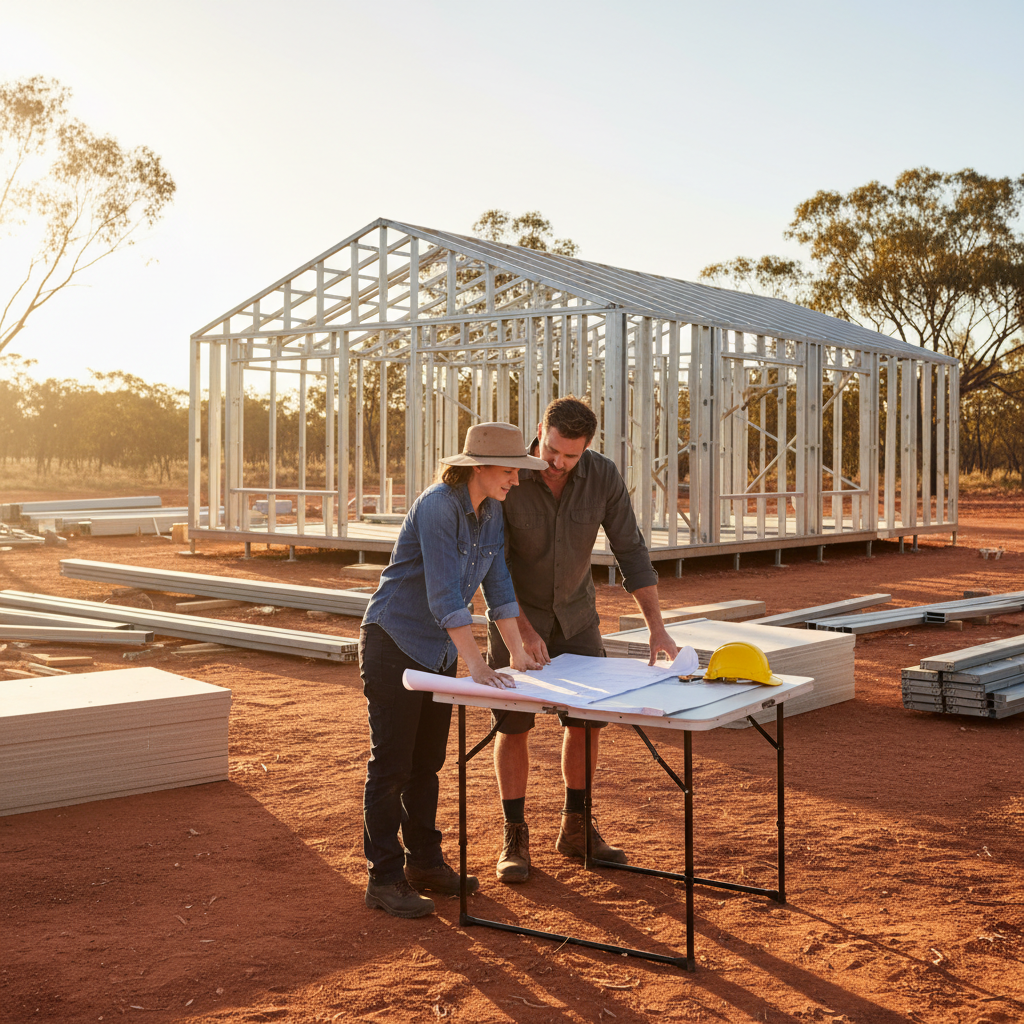
There's a specific sound when you're working with steel frames. It's the snap of a Tek screw biting into the metal. It's different from the thud of a nail gun. For a kit home buyer, this predictability is everything. You get these frames delivered, and they're lightweight. You aren't breaking your back. You can often stand up a whole wall section with just two people. Plus, there is zero waste. If you've ever walked past a timber build site, you'll see a skip bin full of offcuts and warped wood. That's money sitting in the bin. With our kits, every piece is engineered to fit. It's like a giant Meccano set for adults.
But let's be real for a second. Steel can be loud. When the sun hits a metal roof or the frame expands slightly in the morning heat, you might hear a tick or a creak. Modern insulation and thermal breaks have mostly fixed this, but don't let anyone tell you steel is silent. It's a trade-off. Give me a tiny tick in the morning over a door that won't close every summer any day of the week.
Termites and the Australian Reality
We live in the termite capital of the world. I've seen houses in the Northern Territory where termites have literally eaten the structural integrity out of a wall before the owners even knew they had a problem. Steel is a non-combustible, termite-proof material. It's 100 percent literal peace of mind. You don't have to douse your soil in chemicals every few years. The frame itself isn't on the menu. This is a massive win for owner builders who want to build once and forget about the structure. Focus on your tiling or your landscaping instead of worrying about munching sounds in the walls.
The Accuracy of Openings
When you're installing windows and doors into a steel frame kit, you'll notice something quickly. The rough openings are exactly what the plans say they are. In the old days, we'd have to plane down timber studs just to get a sliding door to sit flush because the wood had puffed up in the rain. Steel doesn't absorb water. If your kit arrives on site and it rains for a week before you can get the roof on, it doesn't matter. The steel won't rot, it won't swell, and it won't grow mould. You just wipe it down and keep going when the sun comes out.
Owner Builders and the Learning Curve
So, you're thinking about doing this yourself? Good on you. It's a massive undertaking but incredibly rewarding. One tip I always give: get a good quality impact driver. Don't go cheap on the tools. Driving thousands of screws into TRUECORE steel requires a bit of grunt and a steady hand. Also, wear gloves. The edges of steel frames can be sharp, especially the factory-cut ends. It's a different way of working than wood, but it's much more logical. Everything is pre-punched for your electrical and plumbing. You aren't standing there with a spade bit boring holes through every stud and weakening the structure. The holes are already there, exactly where they need to be, lined with plastic grommets so your wires don't chafe. It's a cleaner way to build.
And then there's the weight factor. Steel has a much higher strength-to-weight ratio than timber. This means we can design larger open-plan living areas without needing massive, heavy lintels that require a crane to install. For a DIY builder, being able to handle most of the components by hand is a game-saver. It keeps your rental costs down because you isn't hiring heavy plant every second day.
Designing for the Australian Climate
Whether you're building a tiny weekender in the Victorian High Country or a family home on the coast, the structure needs to handle the stress. Steel handles high wind loads and cyclonic conditions brilliantly. Because the connections are screwed and bolted rather than just nailed, the whole house acts as one rigid unit. It's predictable. Engineers love it for a reason.
One thing people ask is about rust. We use galvanised and coated steels designed specifically for the Aussie environment. Unless you're building right on the surf spray where the salt is literally hitting the walls, these frames will outlast us all. And even then, there are coatings for that. It’s about choosing the right tool for the job. Our homes include the frames, the roofing, and the cladding, all designed to work as a system. It's not a hodgepodge of materials from five different suppliers.
The Final Word on Straight Walls
At the end of the day, you want to stand back and look at your finished home and see straight lines. You want your skirting boards to sit flush against the wall without huge gaps of gap-filler. You want your kitchen to look like a pro installed it. All of that starts with the bones of the house. If the bones are crooked, the house is crooked. Steel gives you a head start that timber simply can't match. It’s about taking the guesswork out of the project. You've got enough to worry about with councils, tradies, and choosing the right shade of white for the walls. Don't add "warped timber" to your list of headaches. Stick with steel, do it right the first time, and you'll have a house that stays square for a lifetime.