The Foundation of a Forever Home: Understanding Dimensional Stability
When you embark on the journey of building your own home in Australia, you are not just looking for a roof over your head. You are looking for precision, longevity, and a structure that will stand up to the unique rigors of the Australian climate. This is where the technical concept of dimensional stability becomes the most important factor in your build. While the term might sound like engineering jargon, it is the secret ingredient that ensures your doors don't stick, your walls don't crack, and your roofline remains as straight as a die for fifty years.
In the world of kit homes, the choice of framing material is the most critical decision an owner builder will make. For decades, timber was the default, but as Australian homeowners become more savvy, steel frame construction has moved to the forefront. The reason is simple: steel is a predictable, engineered product that does not react to the environment the way organic materials do. Let's dive into why dimensional stability matters and how it changes the game for your construction project.
The Problem with Movement: Warping and Shrinking
To understand the benefits of steel, we first have to look at the challenges of traditional materials. Timber is a hygroscopic material, which means it behaves like a sponge. It absorbs moisture from the humid Australian air and releases it during the dry seasons. This constant cycle of absorption and evaporation causes the wood to swell, shrink, twist, and bow. In a kit home context, this movement can be a nightmare for an owner builder.
When a frame moves, it doesn't move in isolation. It takes everything else with it. As timber studs shrink, they pull away from the plasterboard, leading to unsightly nail pops and cracks in your cornices. When a plate warps, it can cause your flooring to become uneven or create gaps in your insulation. By choosing steel frame construction, you are eliminating these variables from the very beginning. Steel is inorganic. It does not contain moisture, and it does not react to humidity. A steel stud is the exact same shape and size when it arrives on your site as it will be twenty years after you move in.
Precision Engineering with BlueScope TRUECORE Steel
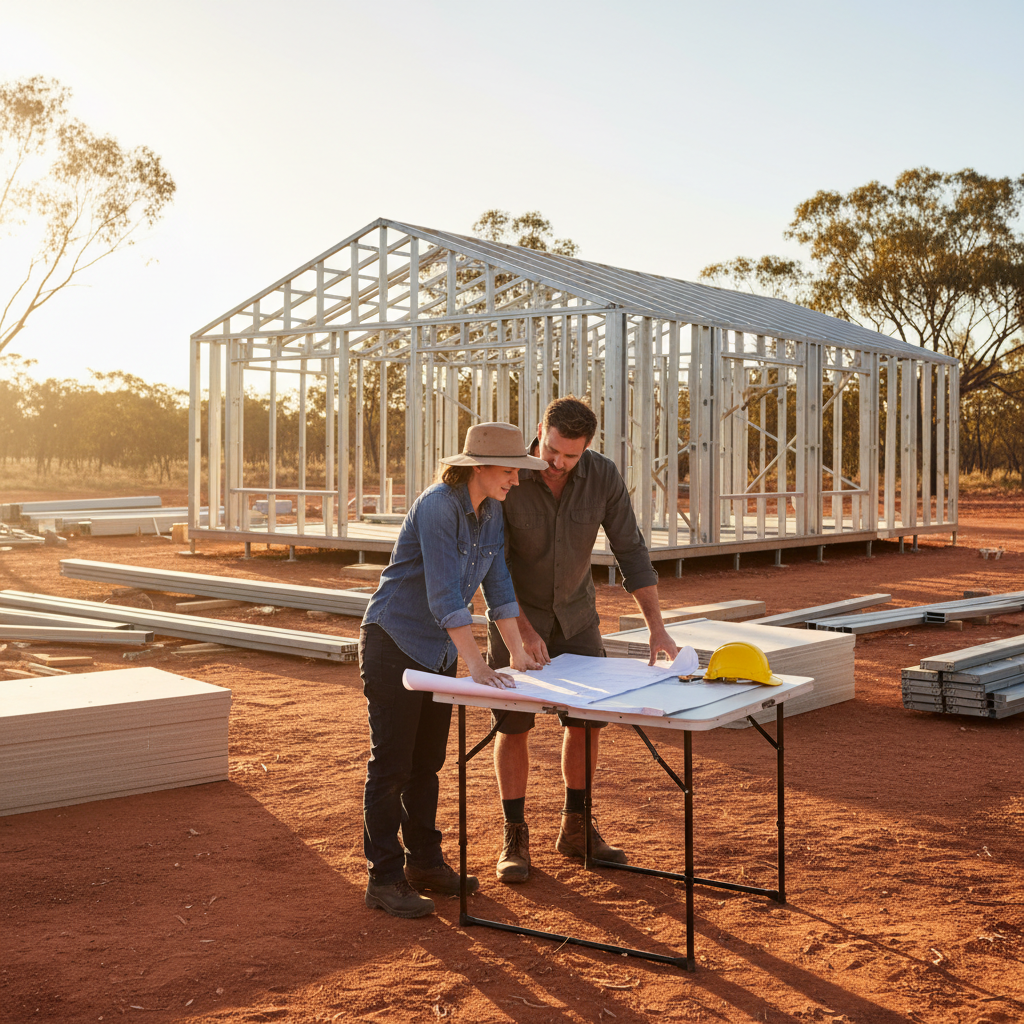
One of the standout advantages for Australian kit home builders is the use of high quality materials like BlueScope TRUECORE steel. These frames are not just cut to length, they are precision engineered using advanced computer aided design. Because steel is manufactured to strict tolerances, every piece fits together with millimetre perfect accuracy.
For the owner builder, this precision is a massive confidence booster. When you are assembling your kit on site, you aren't fighting with crooked studs or trying to plane down a joist that has a hump in it. The dimensional stability of steel means that every corner is a true ninety degrees and every wall is perfectly plumb. This level of accuracy flows through to every other stage of the build. Your windows will fit into their openings without a struggle, and your kitchen cabinetry will sit flush against the walls without the need for extensive shimming.
Why Straight Walls Matter for Your Interior Finish
A home is often judged by its finish, but a high quality finish is only possible if the bones of the house are straight. Professional tradespeople, such as vertical tilers and plasterers, love working on steel frame kit homes because the surface they are working on is uniform and stable.
Imagine laying expensive large format tiles in your new bathroom. If the framing behind the wall shrinks or twists even slightly, it can cause the waterproof membrane to stress or the tiles to crack at the grout lines. Steel frames provide a rigid, unchanging substrate. This means your paint jobs stay smooth, your wallpaper stays flat, and your tiling remains pristine. For an owner builder who is perhaps doing some of the interior work themselves, having a perfectly straight wall to work with makes the DIY process significantly easier and more professional looking.
The Environmental Advantage: Standing Up to Australian Extremes
Australia is a land of extremes. From the tropical humidity of Queensland to the dry heat of the Victorian summer, our homes are under constant environmental pressure. Steel frames are uniquely suited to this landscape because they are unaffected by these shifts. While timber may groan and creak as it expands and contracts during a cold night after a hot day, steel remains silent and stable.
Furthermore, the dimensional stability of steel offers a hidden benefit: termite resistance. Because steel frames are not an organic food source, you don't have to worry about the structural integrity of your home being compromised by pests. This provides immense peace of mind for homeowners in high risk termite zones, knowing that the skeleton of their house is invincible to such threats.
Practical Tips for Owner Builders Working with Steel Frames
If you are considering a steel frame kit home, here are some practical tips to help you get the most out of this superior material:
- Trust the Plan: Because steel frames are pre engineered, don't try to modify them on site. The strength of the system relies on the design. If you need a change, consult with your kit provider before you start assembly.
- Use the Right Fasteners: Steel frames require specific screws and fasteners. Your kit will typically include these, but always ensure you are using the recommended tools, like a high quality impact driver, to make the assembly process smooth.
- Appreciate the Lightness: Steel has a very high strength to weight ratio. This makes the frames easier to manhandle on site compared to heavy, wet timber. It reduces fatigue for the owner builder and makes the assembly process faster.
- Service Holes are Pre-Punched: One of the best features of steel frames is that holes for electrical wiring and plumbing are usually pre-punched. This saves you hours of drilling and ensures that your services are run neatly through the centre of the studs, maintaining the structural integrity of the wall.
The Long Term Value of Stability
Building a kit home is a significant investment of time and resources. When you look at the long term maintenance of a property, steel frame homes consistently outperform their counterparts. Because the structure does not settle or shift due to moisture loss, you will spend significantly less time and money on maintenance tasks like patching plaster cracks, re-aligning doors, or fixing sticking windows.
This stability also contributes to the overall energy efficiency of the home. When a frame shifts, it can create tiny gaps around window frames and door seals, leading to air drafts that make your heating and cooling systems work harder. A stable steel frame maintains the tight envelope of the building, helping your insulation do its job effectively and keeping your energy bills lower.
Conclusion: A Straight Path to Your New Home
Choosing a kit home with a steel frame is about more than just modern technology, it is about choosing a stress free future for your house. The dimensional stability of steel solves many of the traditional headaches associated with residential construction. By eliminating warping, twisting, and shrinking, you are ensuring that your home remains as beautiful and structurally sound as the day it was finished.
For the Australian owner builder, the benefits are clear. You get a house that is easier to build, requires less maintenance, and stands up to the toughest conditions our continent can throw at it. When you build with steel, you are building for the future, with the confidence that your walls will stay straight, your roof will stay true, and your home will be a sanctuary for generations to come.