You're sitting at the kitchen table with three different floor plans spread out, and frankly, they're all starting to look the same. It's a classic trap. People get so caught up in where the fridge goes that they forget the big stuff, the structural and logical stuff that actually dictates whether your build is a dream or a total nightmare. I've spent 15 years watching blokes and families tackle kit homes across Australia, and the ones who succeed are the ones who ask the awkward questions early. Real questions, not just 'how many bedrooms'.
1. Is this design actually rated for my specific site?
Australia isn't just one big flat backyard. If you're building on the coast near Coffs Harbour, your wind loading requirements are worlds away from someone tucking a granny flat into a sheltered suburb in Melbourne. You need to know the wind classification. Is it N2? N3? C1 for cyclonic areas? Don't assume the kit you see on the website is 'plug and play' for your block. If the steel frames aren't engineered for your specific wind zone, the council DA will hit a brick wall before you even turn a sod. Ask the supplier if their standard price includes engineering for your specific site conditions. It’s a huge detail. If it doesn't, you're looking at extra costs for beefed-up TRUECORE steel sections or extra bracing later on when you can least afford it.
2. What exactly is the 'line of supply' for the kit?
This is where things get messy for first-timers. You see a beautiful render and think that's what shows up on the truck. It isn't. A kit usually means the 'shell' - the bones and the skin. We're talking the internal and external wall frames, the roof trusses, the BlueScope sheeting, the windows, and the doors. But go deeper. Ask about the flashing. Ask about the screws, the sealant, and the insulation batts. Does it include the internal plasterboard? Usually not. Does it include the skirting boards or the kitchen cabinets? Definitely not. You need a dead-set list of what is in that crate. Because when the truck pulls up and you realize you're missing the sarking, your build stops. And stopping costs money every single day. I've seen it happen. A guy in Goulburn had his whole crew ready to go, but the windows were on a different lead time. Chaos.
3. How does this design handle Bushfire Attack Levels (BAL)?
It’s the reality of living in the Aussie bush or even on the fringes of town. If your land is rated BAL-12.5, BAL-29, or the dreaded BAL-FZ (Flame Zone), your choice of kit home design changes instantly. You can’t just chuck standard glass in a high-risk zone. You need to ask: 'Can this design be modified for BAL ratings?' Steel frames are a massive win here because they're non-combustible, which gives you a leg up. But you still need to think about mesh screens on windows, specific door seals, and the type of cladding you're using. If you pick a design with a massive timber deck and you're in a high BAL area, you're asking for trouble from the local council. Get this sorted during the design phase, not when the building inspector shows up and tells you to rip out your windows.
4. Can I actually manage the weight of these components?
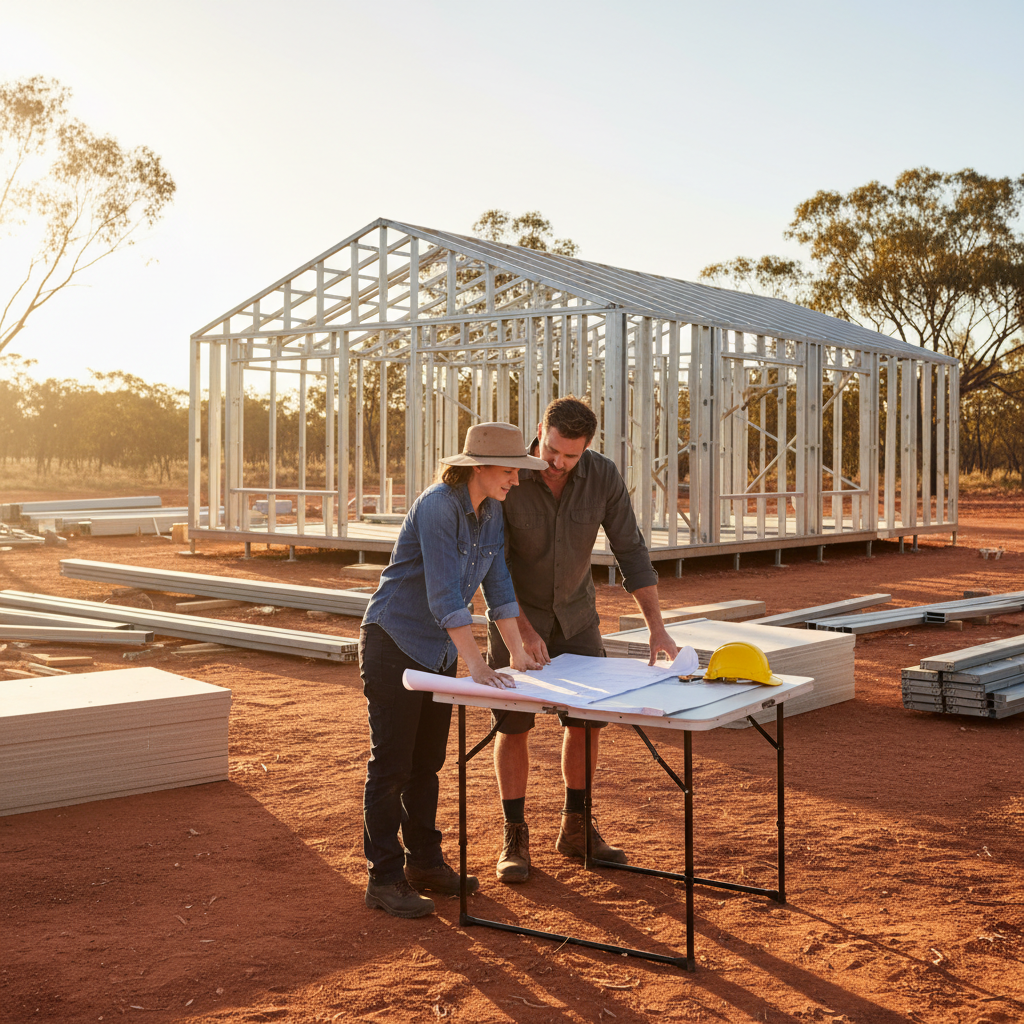
Let's talk about the physical reality of being an owner-builder. Some kit designs use massive, heavy spans. If you're planning on doing a lot of the heavy lifting yourself with a couple of mates on the weekend, you need to know if you'll need a crane or a beefy telehandler. Steel frames are generally lighter than timber, but a fully assembled roof truss is still a beast. Ask the supplier how the kit arrives. Is it pre-assembled wall panels or is it 'stick and tin' where you're screwing every stud together on site? There's a trade-off. Pre-assembled is faster but requires more muscle or machinery to move. Know your limits. Your lower back will thank you three weeks into the build.
5. Is there flexibility with the internal floor plan?
One of the best things about using a steel frame kit is that the strength is in the perimeter and the trusses. This often means you don't need a heap of load-bearing internal walls. But you have to ask. If you want to move the wall between the kitchen and the lounge to create a massive open-plan space, can the engineer make that work? Don't just start moving lines on a piece of paper. If you mess with the structural intent of the kit, you’re basically starting a custom design from scratch, which is more expensive. Ask if the design allows for 'non-structural' internal wall placement. It gives you the freedom to tweak the layout without needing a whole new engineering certificate.
6. What’s the go with the plumbing and electrical runs?
People forget that once the frames are up, you've got to get the guts of the house in. Steel frames come with pre-punched holes for your wiring and pipes. This is a godsend. But you need to check the design. Are the wet areas (kitchen, bathroom, laundry) clustered together? If your bathroom is at the opposite end of the house from the laundry, your plumbing costs are going to skyrocket. More trenches, more pipe, more labor. A smart kit home design keeps the wet areas back-to-back or close by. It’s a pro move that saves you thousands in trade costs. Look at the plan and trace where the pipes go. If it looks like a maze, it’s a bad design.
7. How do we handle the slab-to-frame connection?
This sounds boring. It's actually the most important 50mm of the whole house. Is the design intended for a concrete slab or a raised floor system with steel stumps? If you’re on a sloping block in the Hinterland, a slab is going to cost you a fortune in site works and retaining walls. You might be better off with a floor system on stumps. Ask the supplier if the design can be adapted for both. Also, get the exact specifications for the slab edge. Your concreter needs to be spot-on. If the slab is 20mm out, your steel frames won't sit right, and you’ll be chasing your tail for the rest of the build. Accuracy is everything. Steel doesn't warp or bend like timber, so your concrete has to be perfect.
The Reality Check
Building your own place is a massive undertaking. It's not like the TV shows where it's finished in an hour-long episode. It's months of mud, sweat, and phone calls to tradies who don't call back. But it’s also the only way most of us can afford a decent home these days. Don't be afraid to be a pest with your kit supplier. If they're a good mob, they'll answer your questions because they want the build to go smoothly too. They don't want you calling them at 7am on a Saturday because you've realized the windows don't fit the openings. Get the details sorted now. Read the fine print. And for heaven's sake, make sure you've got a dry place to store your materials when they arrive, because as soon as that truck shows up, it's guaranteed to rain. That's just the way it goes.