The biggest shock for most owner builders isn't the cost of a bag of rapid-set or the wind blowing your site fence over. It's the silence. You spend four months obsessing over floor plans and checking the delivery schedule for your BlueScope steel frames, but when you finally start ringing sparkies or chippies to help with the fit-out, nobody picks up. Or worse, they say they'll show up Tuesday morning and by Friday arvo you're still sitting on a milk crate in the dirt, staring at a silent driveway.
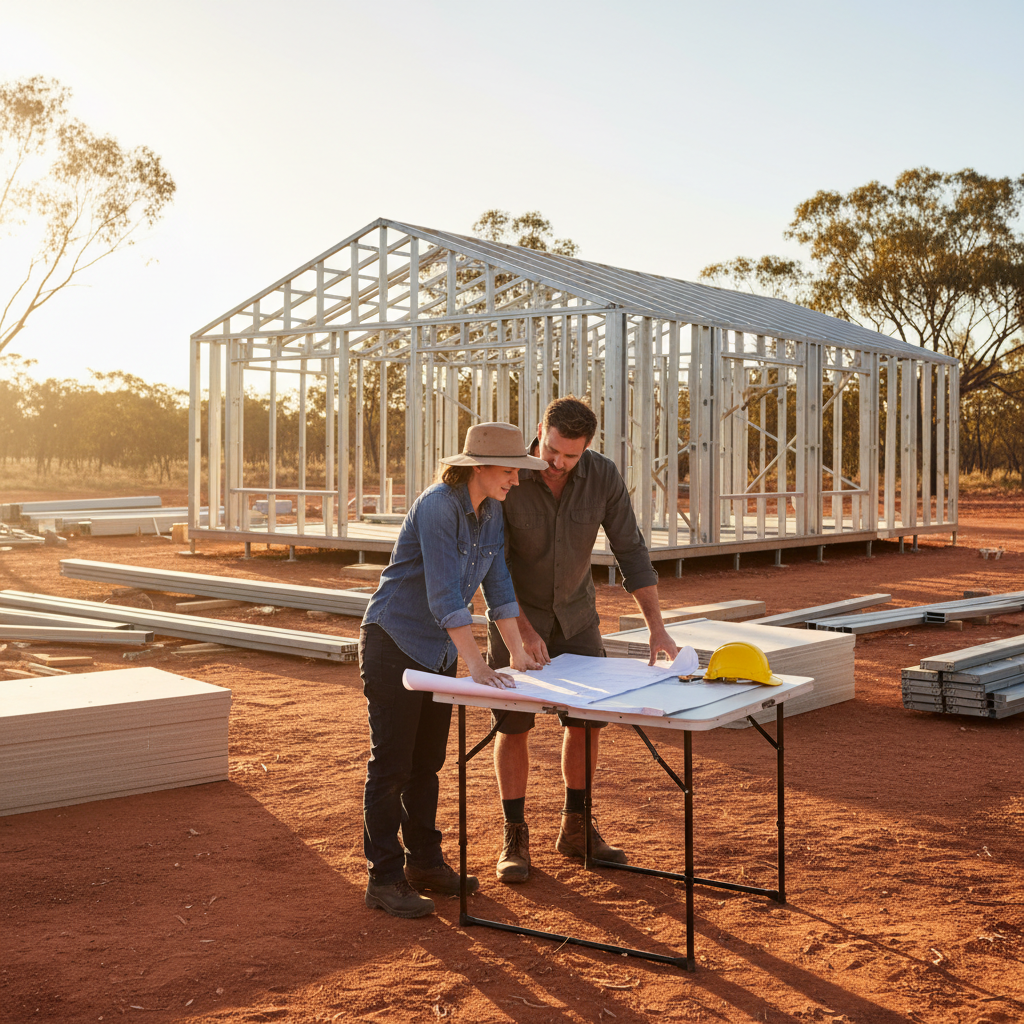
Dealing with trades on a kit home build is different to a standard renovation. You aren't just the client. You're the project manager. If you want a plumber to take you seriously when you're building a kit home in a paddock out past Dubbo or on a tight block in the suburbs, you have to stop acting like a customer and start acting like a site supervisor. They want to know you've sussed out the site access, the slab is level, and the TRUECORE steel is ready to be worked on. If you sound like you don't know your AS 2870 from your elbow, they'll quote you the 'headache' rate. That's if they quote at all.
The Art of the First Phone Call
Don't call a tradie at 7:30 am. They're on the tools, probably wrestling with a circular saw or trying to get a compressor started in the cold. Try the drive home, around 4:00 pm. That's when they're open to talking. And please, for the love of everything, don't start the conversation with "I'm looking for a rough idea on price." That's the fastest way to get a dial tone.
Be specific. Tell them exactly what the job depends on. "I'm owner-building a steel frame kit home in Goulburn. Slab is going down next month, I've got the engineering drawings and the plumbing layout ready to email. Are you interested in quoting the rough-in?" This tells them three things immediately. You've got a timeline. You've got documentation. You aren't just dreaming. It's about respect for their time. Most of these blokes have been burnt by owner builders who change their mind fifty times or don't have the site ready when they arrive. Prove you aren't that person.
Documentation is Your Best Friend
You can't just point at a pile of steel and say "build that." A kit home comes with a massive stack of technical drawings and assembly manuals. Spend your Sunday nights reading them. If a chippie asks how the window flashing integrates with the cladding you've chosen, you need to know the answer. Or at least know exactly which page of the manual it's on. I've seen builds stall for weeks because the owner builder couldn't explain the specific screw patterns required for the steel trusses. Don't be that guy.
Create a physical folder for the site. Put it on a temporary bench. Every trade that walks on should see the engineering for the frames, the BAL rating requirements if you're in a bushfire zone, and the energy efficiency report. If you're building to a BAL-29 or BAL-40, the sealing requirements for your doors and windows are strict. If the sparkie knows you're onto it, he won't try to take shortcuts with wall penetrations that'll fail your final inspection.
The Difference Between Help and Interference
There's a fine line here. You want to be involved because it's your house and your money. But nobody works well with someone breathing down their neck while they're trying to wire a switchboard. Give them space. If you've hired a team to help stand the frames, let them set the rhythm. Your job is to make sure the site is clear, the power is on, and the water is connected. Simple stuff, but you'd be surprised how many people forget to check if the temp power pole actually has credit on it before the crew arrives.
Supply the coffee. It sounds like a cliché, but it works. A box of cold water in the fridge and a decent brand of biscuits goes a long way when the sun is hitting that steel and the temp hits 35 degrees. It's about culture. A happy site is a fast site.
Suppliers and Lead Times
The kit home arrives with the big stuff: the BlueScope steel, the roof sheets, the windows. But as an owner builder, you're responsible for the gaps. The glue, the extra fixings, the internal trimmings. Don't wait until the day you need it to head to the local hardware store. If you need a specific color of Colorbond flashing to match your roof, and they have to order it in, you're looking at a ten-day wait. That ten days might push your plumber's window of availability, and suddenly you're at the back of his queue for another month.
I always tell people to keep a whiteboard in the garage or a shipping container on site. Write down every missing item as you think of it. Order in bulk. Getting one delivery truck to drop off your plasterboard, insulation batts, and internal doors is cheaper and easier than trying to ferry it all yourself in a 6x4 trailer on Saturday mornings. Plus, the suppliers will treat you better if you're placing decent-sized orders. They like customers who know what they want.
Why Steel Frames Change the Conversation
Working with steel is different for some traditional trades. Most love it because it's straight. No bows, no knots, no twists. For the plasterer, it means the walls are actually flat, which makes their life easy. But you need to make sure your sparkie and plumber are comfortable with it. They need the right grommets for the pre-punched holes to protect the cables and pipes. If they've only ever worked on timber, they might moan about it. Just point out that it's termite-proof and won't move when the weather gets dry. Usually, once they see how precise the TRUECORE frames are, they shut up and get to work.
Managing the Schedule Without Losing Your Mind
Construction isn't a straight line. It's a mess of overlapping tasks. You'll have the cladding going on while the electrician is inside doing the rough-in. This is where the communication really matters. If the tiler is coming on Monday, the waterproofed wet areas must be bone dry and untouched. If you let the plumber walk across a freshly waterproofed floor to check a tap, you've just cost yourself a fortune in repairs and delays.
Send a text the Friday before. "Hey mate, still right for Monday 7am? Site is clear and ready for you." It gives them an out if they're running behind, and it reminds them you're organized. If they don't reply, call them. Silence is usually a sign they've overbooked themselves. Better to know on Friday than to find out when they don't show up on Monday morning.
At the end of the day, being a successful owner builder is about honesty. If you don't know something, ask. Most tradies would rather explain a detail for five minutes than spend five hours fixing a mistake you made because you were too proud to look like a novice. You're the boss, sure. But they're the experts in their craft. Find that balance, and your kit home will be finished before you know it, and you might even still be on speaking terms with the folks who helped you build it.