The Floor Plan is Just the Start
Most blokes and plenty of women I talk to spend months staring at the same three floor plans. They know where the couch goes. They've already mental-mapped the walk from the master bed to the ensuite. But here is the thing. A floor plan is a dream, while the specification is the reality. If you don't know the difference between a floor plan and a structural layout, you are going to have a rough time when the steel arrives on the back of a semi-trailer in the middle of a dusty Tuesday morning.
I once saw a guy in Gympie who thought the 'dotted lines' on his plan were just decoration. Turns out they were significant structural overhangs for his roofline. He hadn't budgeted for the extra scaffolding. It cost him two weeks and a few grand he didn't have. Understanding these documents isn't about being an architect. It's about making sure that what you think you're buying is actually what's getting bolted together on your slab.
Deciphering the Steel Frame Layout
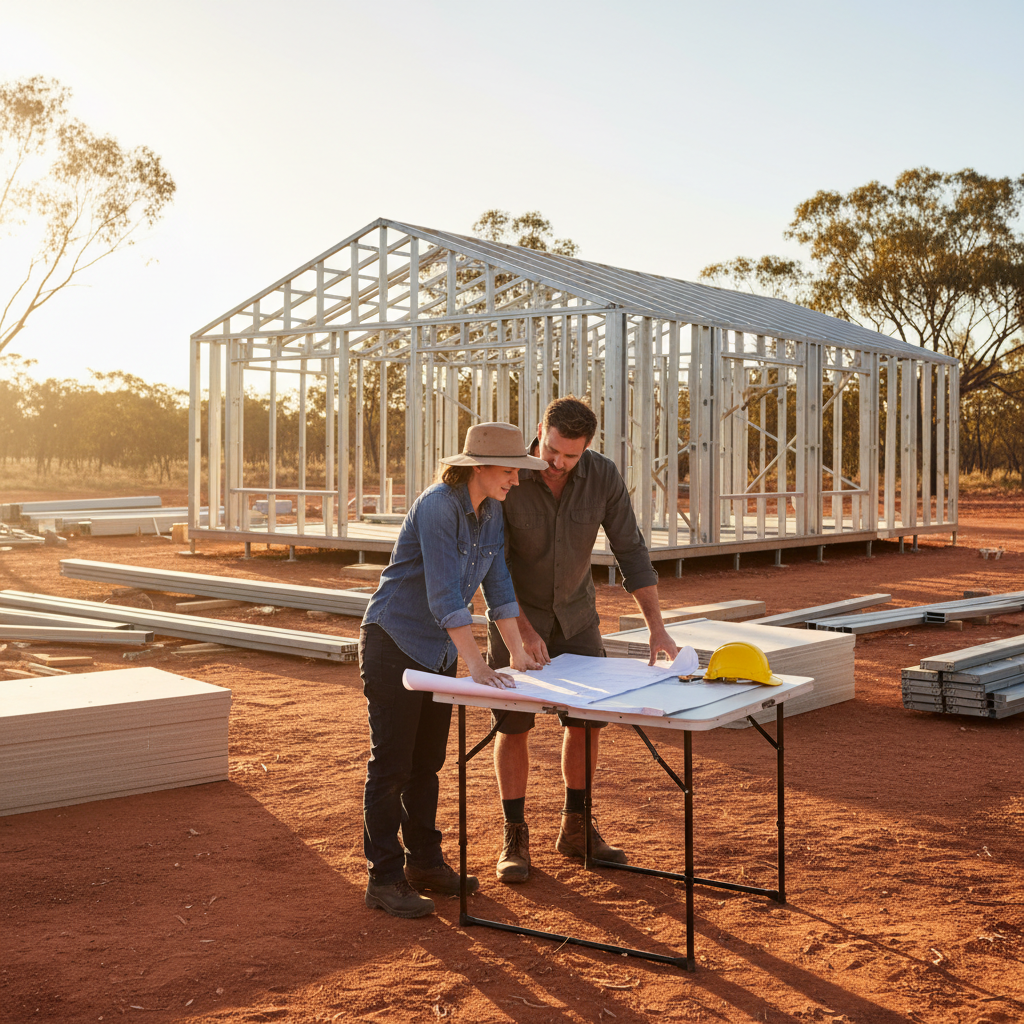
In the world of kit homes, your frame is your backbone. We use TRUECORE steel from BlueScope because it's straight as a die and termites won't touch it, but reading those frame layouts can be a bit of a headache at first glance. You'll see codes like 'W1' or 'D2'. These aren't secret spy codes. They're just markers for your window and door openings. Pay attention to the 'RO' dimension. That stands for Rough Opening. If you order a window that is exactly the size of the RO, you'll be fighting it for hours with a rubber mallet. You need that 10mm or 20mm of wiggle room to get things plumb and level.
Look for the stud spacing too. Most residential stuff is 450mm or 600mm centres. If you're planning on hanging a massive 75-inch telly or heavy floating shelves in the kitchen, you need to know where those studs are. Better yet, you want to know if there's extra nogging in the wall to support the weight. Don't wait until the plasterboard is up to realise you've got nothing but air behind your expensive wall-mounted cabinets. It's much easier to chuck in some extra steel bracing while the skeletons are still exposed.
The Sections and Elevations: More Than Just Pretty Pictures
Elevations show you what the house looks like from the side. Neat. But the 'Section' is where the gold is hidden. Imagine taking a giant chainsaw and cutting the house right down the middle, then looking at it from the side. That's a section. It shows you the height of the ceilings, the pitch of the roof, and how the insulation sits in that cavity. Because we include the roofing, cladding, and insulation in the kit, you need to see how they all sandwich together.
Check your ceiling heights carefully. A lot of standard plans sit at 2.4 metres. If you're a tall person or you just like the feel of a bit of air over your head, you might want to bump that to 2.7 metres. But remember, that changes your cladding requirements and your frame heights. It's not just a 'quick swap'. It's a fundamental change to the bones of the building. Plus, your windows might look a bit 'squat' if you raise the ceiling without adjusting the head heights of your doors. Details matter.
Specifications: The Shopping List
The 'Spec' is the most important document you'll ever read. It's the contract, basically. If it's not in the spec, it's not in the kit. Simple. Our kits come with the frames, the BlueScope roofing, the cladding, and the windows. But as an owner builder, you're the boss of the rest. You're the one hiring the sparky, the plumber, and the tiler. You're the one picking out the taps from the local hardware shop.
So, when you look at the spec sheet, check the wind rating. This is non-negotiable in Australia. If you're building in a cyclone-prone spot in North Queensland or a high-wind ridge in the Blue Mountains, your frame and your fixings need to match that N3 or C2 rating. If the plans say N2 and your council site report says you need N3, stop everything. You'll need more bracing, closer screw patterns, and potentially thicker steel. Check this before you sign anything. Council won't give you the final tick if your engineering doesn't match the dirt you're building on.
The Stuff That Isn't There
This is where new builders get tripped up. A kit home is a specific package of materials. It doesn't include the concrete for your slab. It doesn't include the copper pipe for the plumber. It definitely doesn't include the electrician's time to wire up your LED downlights. When you're reading the plans, you see toilets and sinks drawn in. Those are just 'indicative'. They show you where they go so the plumber knows where to bash the pipes through the slab. But we don't supply the porcelain. You get to choose the fancy matte black taps or the classic chrome ones yourself.
And let's talk about insulation for a second. We include it because building a steel-framed house without good bulk insulation and a thermal break is a recipe for a sweatbox in a Melbourne summer. Look at the R-value in the specs. The higher the number, the better the heat resistance. If you're building in the Snowies, you'll want to beef that up. If you're in a BAL (Bushfire Attack Level) zone, your specs need to reflect that too. Mesh over the weep holes, specific glass for the windows, even the way the roof joins the walls needs to be tight to stop embers getting in.
Symbols You Need to Know
You'll see a bunch of hieroglyphics on the pages. A triangle with 'RL' next to it? That's your Relative Level. It tells the earthmovers how much dirt to shift. A circle with a cross in it? Usually a floor waste. If you see 'AS' followed by a number, like AS 3959, that's an Australian Standard. That one specifically covers building in bushfire-prone areas. Don't ignore those. The building inspector definitely won't. They'll be checking that your windows have the right seals and your cladding has the right fire rating as per that specific standard.
Also, look at the door swings. It sounds stupid, but look at which way the doors open. If your laundry door opens and hits the washing machine, you'll be annoyed for the next twenty years. It's a five-second fix on a plan, but a massive pain once the frames are up and the hinges are set. Take a pen. Walk through the 'paper' house. Open every door in your mind. Does it hit the towel rail? Is the light switch behind the door when you walk in? Fixing it now costs nothing.
Owner Builder Responsibility
You are the site manager. That means you've got to coordinate the delivery of these kits. When the truck arrives, you need to check the delivery manifest against your spec sheet. Don't just wave the driver off and start a barbie. Check for damage. Check the count on the bundles of cladding. If a window is smashed, you need to know then, not three weeks later when the installer is standing there on double-time waiting for something to do. Being an owner-builder is about being a hawk for detail. It's hard work, but when you're sitting on that deck you built yourself, looking at a roof you saw go up sheet by sheet, it's worth every single headache.