I remember standing on a job site in rural Victoria about twelve years ago, watching two blokes try to correct a bowed timber stud with a power planer and a lot of swearing. It was 38 degrees, the flies were thick, and they were losing half a day's work because the wood had decided to twist while sitting on the rack. That's the reality of traditional building. Wood is alive. It moves, it shrinks, and it's rarely as straight as the bloke who sold it to you claims it is.
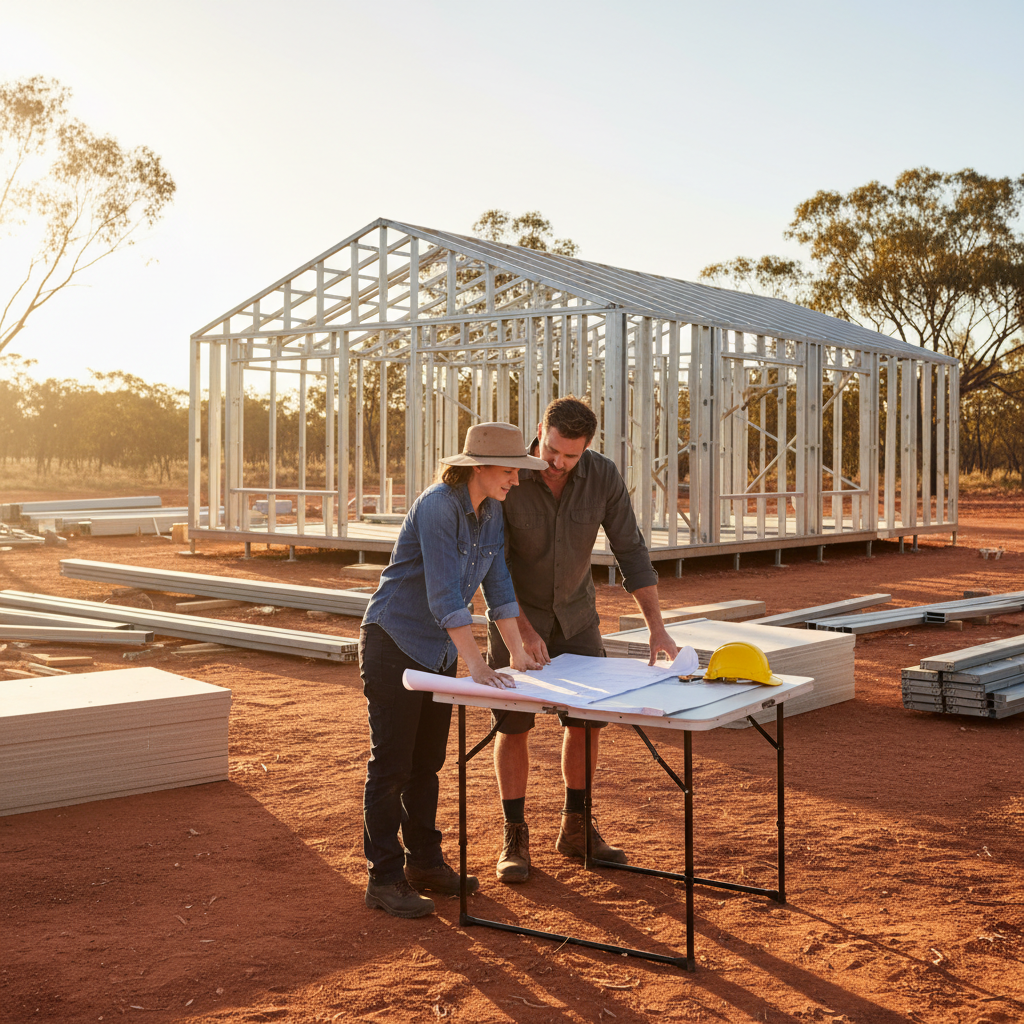
When you start looking at kit homes in Australia, you'll see a massive shift toward steel. It isn't just because it's lighter or termite-proof, though those are big wins. The real hero is the precision engineering. We're talking about frames designed on CAD software and punched out by machines with millimetre perfect accuracy. You aren't just buying a pile of sticks. You're buying a technical system.
The Myth of 'Near Enough' on an Australian Building Site
In the old days, 'near enough was good enough' for most residential builds. If a wall was 5mm out over a 3-metre span, the plasterer would just go heavy on the base coat and hide the sins. But try installing a modern kitchen or large-format floor tiles in a wonky house. You'll see the gaps. Everything will look slightly off.
With BlueScope TRUECORE steel, that nonsense goes out the window. Because the frames are engineered in a controlled factory environment, they don't arrive on your block with knots, wanes, or twists. They arrive straight. They stay straight. This matters immensely for owner-builders because you probably don't have forty years of experience to 'cheat' a straight line out of a crooked piece of pine. You need the gear to be right before it leaves the truck.
Why Millimetres Matter in Kit Homes
Let's talk about the technical side for a second. Most kit homes we're seeing across NSW and Queensland now use cold-rolled steel. This stuff is fed through a series of rollers that shape it into a C-section or a top hat profile. The software tells the machine exactly where to punch the service holes for your sparks and your plumber.
Think about that. Your electrician isn't going to be core-drilling through your frame and potentially weakening it. The holes are already there, exactly where the engineering says they should be. It makes the rough-in phase much faster. Plus, the screws go in and they stay put. Steel doesn't have a grain, so you don't have to worry about the screw following a soft patch in the wood and coming out at a weird angle.
The Termite Problem: More Than Just a Spray
If you're building in the Northern Territory or even parts of WA, termites are a genuine force of nature. I've seen them eat through a timber-framed shed in months. People think a bit of chemical treatment in the ground is a silver bullet. It's not. Chemicals leach away, or a garden bed gets built over the barrier, and suddenly the 'white ants' have a bridge.
Steel is 100 percent termite proof. It's not just 'resistant'. They can't eat it. Period. This gives you a level of peace of mind that no chemical spray can match. And because the frame is the skeleton of your kit home, having it made of something inorganic means your structural integrity isn't at the mercy of some hungry insects under the slab.
But there's a trade-off. Steel is a great conductor of heat. We can't ignore physics. If you live in a place like Alice Springs or even Western Sydney, you've got to be smart about your thermal breaks. You don't just whack the cladding straight onto the steel and hope for the best. You need that insulation layer and often a thermal break strip to stop the heat from transferring from the outside skin straight into the frame. It's a simple step, but skip it and you'll feel the cold in winter and the heat in summer.
Bushfires and BAL Ratings
Living in Australia means dealing with the reality of bushfires. Lately, the Bushfire Attack Level (BAL) requirements have gotten a lot stricter. If you're building in a BAL-40 or BAL-FZ (Flame Zone) area, a steel frame kit home is practically a requirement. Steel doesn't add fuel to the fire. While no house is totally fireproof, having a non-combustible frame is a massive leg up when you're trying to meet the NCC Volume 2 requirements for fire safety.
The engineering behind these frames also takes wind loads into account. Whether you're in a Region C cyclone zone or just a gusty spot on the coast, the connections in a steel kit are incredibly strong. We use specific screw patterns and brackets that are engineered to stay put when the wind tries to lift the roof off.
Practical Tips for the Owner-Builder
So, you've decided to go the steel route. What do you actually need to know on the tools? Here's my take after years of seeing people tackle this:
- Invest in a decent impact driver. Don't try to use your old $50 drill from the back of the garage. You'll be driving thousands of tek screws. Get a high-quality 18V impact driver and a big bag of spare bits.
- Magnetic levels are your best friend. Since the frame is steel, your level will stick to it. This makes plumbing up walls a one-person job. Absolute winner for DIY blokes.
- Mind the edges. Steel frames can be sharp. Wear your gloves. It sounds like basic advice until you've sliced a finger open on a piece of floor joist.
- Plan your services early. Even though the holes are pre-punched, you need to make sure your plumber knows he's working with steel. He'll need plastic grommets for his pipes to stop them rattling or corroding against the steel.
Weight and Handling
One thing that surprises most first-timers is how light these frames are. You can often carry a whole wall section with just two people. This is huge if you're building on a site with tricky access where you can't get a crane right up to the slab. You aren't straining your back as much, and the site stays cleaner. No piles of sawdust. No offcuts of timber rotting in the mud.
But don't mistake 'light' for 'weak'. The way steel is engineered into shapes gives it a strength-to-weight ratio that timber can't touch. You can have wider spans without needing massive, heavy beams. This is why you see so many modern kit homes with big, open-plan living areas. The steel does the heavy lifting without the bulk.
The Realities of the Build
Is it all sunshine and roses? No. Nothing in building is. If you want to change a door opening by 100mm on the fly, it's a lot harder with a pre-engineered steel frame than it is with wood. You can't just take a hand saw to it and move a stud. You have to be sure about your floor plan before you hit the 'order' button.
Also, noise can be an issue if you aren't careful. Steel expands and contracts at a different rate than other materials. If you haven't used the right fixings or if the house isn't insulated properly, you might hear a few clicks and pops in the evening as the sun goes down. Most modern kits have solved this with better engineering, but it's something to be aware of.
At the end of the day, building a kit home in Australia is about taking control of your own project. Using a steel frame from a brand like BlueScope gives you a massive head start. It's about getting the structure right, so the rest of the build flows. When the walls are straight and the corners are square, hanging the doors and installing the kitchen becomes a joy rather than a battle. It's that precision that makes the difference between a house that feels like it was built by a pro and one that feels like a weekend hobby project. So, do your homework, suss out your BAL rating, and get stuck in.