Stop Chasing Wonky Walls
Walk onto any suburban building site after a week of heavy rain and you'll see it. Stacks of timber sitting in the mud, soaking up moisture like a sponge. Once those studs are nailed into place and the sun finally comes out, the drama starts. Timber is organic. It breathes. It moves. As it dries out, it bows and twists. You end up with a wall that looks like a dog's hind leg, and good luck getting your kitchen cabinets to sit flush against that mess. This is why I'm massive on steel. Specifically, the BlueScope TRUECORE stuff we use in our Australian kit homes. Steel is dead. It doesn't have a cellular memory of being a tree, so it doesn't try to curl up when the humidity hits 90 percent in Brisbane or drops to a bone-dry frost in Wagga Wagga.
Dimensional stability sounds like some fancy lab term. It isn't. It just means that if a steel stud is 2400mm long when it leaves the factory, it's 2400mm long when you're screwing the plasterboard to it three months later. No surprises. No jammed windows. No clicking sounds in the middle of the night because the house is 'settling'. Most of what people call settling is actually just wood shrinking. Because steel is an engineered product, you get precision that timber can't touch. We're talking tolerances of less than a millimeter. If you're an owner-builder doing your own lining, you'll thank me. There's nothing worse than trying to shim out a wonky stud while you're losing the light on a Sunday afternoon.
The Plaster Crack Nightmare
You've seen those hairline cracks that appear above doorways in older houses. Or the cornices that seem to pull away from the ceiling ever so slightly. That's movement. When a timber frame loses its moisture content, it shrinks. The plasterboard, which is rigid, can't handle that shift. So it snaps. It's a localized failure. If you use a steel frame kit, that risk basically vanishes. Steel doesn't shrink. It doesn't expand in any way that matters for a domestic dwelling built to AS 4100 or AS/NZS 4600 standards. Your paint job stays looking sharp. Your architraves stay tight. It's about less maintenance down the track. Plus, you won't be out there with a planer trying to shave the top off a door because it won't close properly in February.
I remember a job out near Dubbo where the owner was adamant about using wood because it was what his old man did. Six months after move-in, he was calling me back because his sliding stacker door was grinding. The header had sagged just enough as the timber dried out to put pressure on the track. If that had been a steel lintel, we wouldn't have been having that conversation. Steel carries the load without the 'creep' you get with organic materials. It's predictable. And in building, predictable is beautiful.
Straight Lines Make for Fast Trades
If you're managing your own build as an owner-builder, you're hiring chippies, sparkies, and guys to do the internal lining. These blokes charge by the hour or by the sheet. If your frames are dead straight, the plasterers fly through the job. They love steel because they aren't spending half the day using a power plane to flatten out studs that have bowed outward. Every minute they spend fixing a bad frame is money coming out of your pocket. Even the kitchen installers will be happier. Try installing 3 meters of stone benchtop against a wall that's got a 10mm belly in it. It's a nightmare. With a steel kit, your corners are square. 90 degrees means 90 degrees.
Termites Don't Eat Steel
We can't talk about frames in Australia without mentioning the white ants. They're a menace. I've seen homes in North Queensland where the termites have eaten through the studs and left nothing but the paint and the wallpaper holding the room up. It's gut-wrenching. While you still need a termite barrier for your finished bits like skirting boards, the structural skeleton of a steel kit home is completely inedible to them. It gives you that bit of extra sleep-at-night factor. You aren't constantly worried that a breach in your chemical barrier means the roof is going to fall in. Steel is also non-combustible. In a country that burns every summer, having a frame that won't contribute fuel to a fire is just common sense. It's one less thing to worry about if you're building in a BAL (Bushfire Attack Level) rated zone.
Lightweight but Heavy Duty
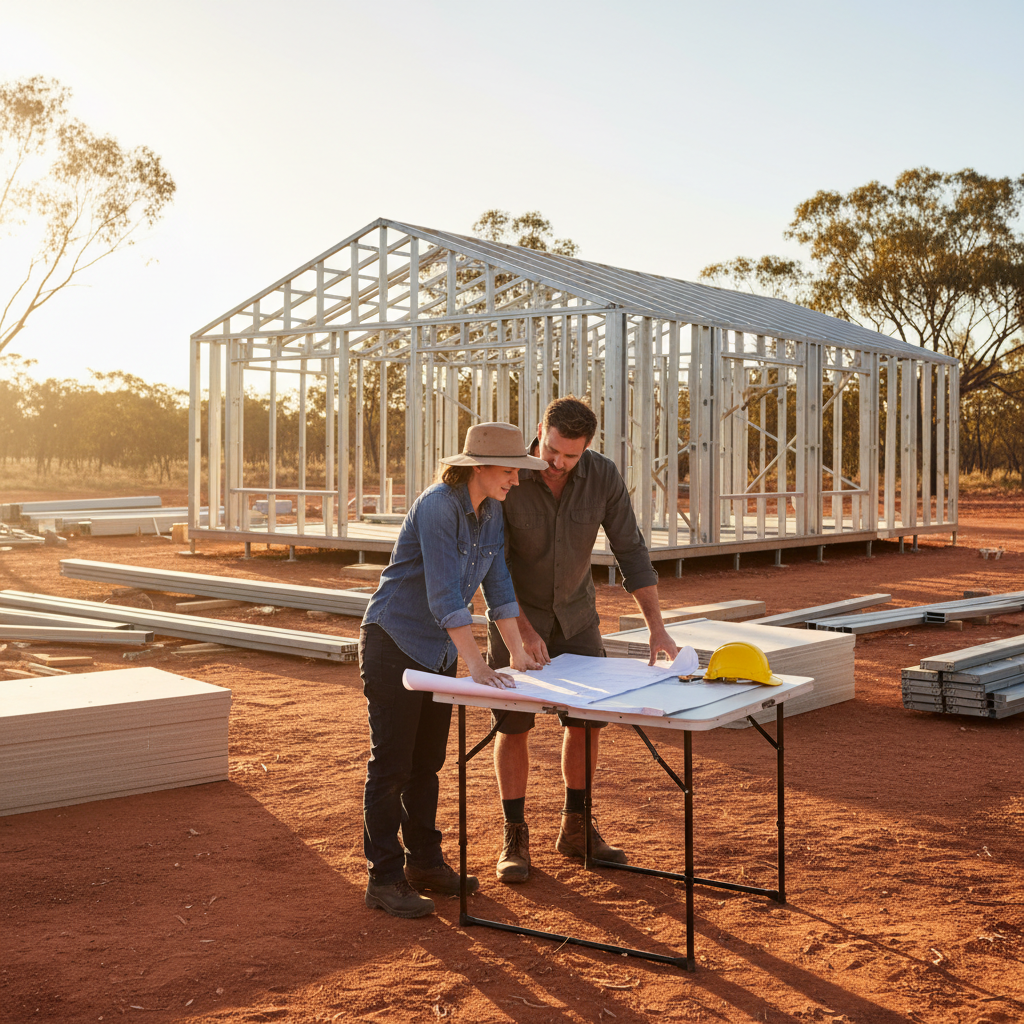
One of the biggest shocks for first-time builders is how light steel frames actually are. You can carry a whole wall section with two people easily. This is a massive win for DIY enthusiasts who don't have a crane on site or a dozen mates to help with the heavy lifting. But don't mistake that lightness for weakness. The strength-to-weight ratio of cold-formed steel is through the roof. It's why we can achieve those big open-plan living areas that everyone wants these days without needing massive, expensive timber beams that require a specialized rig to install. You get the spans you want without the weight penalty.
Because the frames are manufactured using CAD software and CNC machines, every service hole is already punched. You aren't standing there with a spade bit drilling holes for electrical cables or plumbing pipes and leaving a mess of sawdust everywhere. The sparky just pulls the wire through the grommets. It’s cleaner. It’s faster. And it’s smarter.
Dealing with the Myths
People reckon steel homes are noisy. They think they'll hear 'bangs' every time the sun goes down. That’s old-school thinking from 30 years ago when people didn't know how to fix them properly. Modern steel frames used in kit homes are designed with thermal breaks and specific fixing methods that handle thermal expansion silently. If the home is insulated right, you won't hear a peep. Speaking of insulation, we include it in our kits because it's vital. You treat the house as a system. The steel is the skeleton, the cladding is the skin, and the insulation is the guts that keeps it all humming.
Another one is the 'rust' worry. We use TRUECORE steel which has a zinc/aluminium/magnesium alloy coating. It’s designed for the Aussie climate. Unless you’re building right on the surf where the salt spray is hitting the frame daily, it’s going to outlast us all. Even then, there are ways to manage it. For the vast majority of us in the suburbs or out on a few acres, it's a non-issue.
Building your own home is a massive crack at the Australian dream. It's stressful, sure. You'll spend plenty of arvos scratching your head over a site plan. But choosing a steel frame takes a whole category of potential disasters off the table. You won't be dealing with rot, you won't be fighting termites in the walls, and you won't be looking at a cracked ceiling in two years wondering where it all went wrong. You want a house that stays where you put it. Steel does that. It's as simple as that. Put your energy into picking the right tiles or the best deck oil, and let the steel handle the heavy lifting of keeping your house straight and true.