I have spent fifteen years looking at floor plans. Most people make the same mistake. They look at a 2D drawing and imagine a perfect, tidy life where nobody ever drops their muddy boots in the hallway or leaves the mail on the kitchen island. That is not how it works in the real world. A floor plan is not just about where the walls go, it is about how you move from the fridge to the couch at 7pm on a Tuesday while the kids are arguing about the remote.
The Myth of the Open Plan Everything
Open plan living has been the king of Australian design for two decades now. We love it because it feels big. But it has a massive downside. Noise. If you have a combined kitchen, dining, and lounge area, you can hear the dishwasher, the TV, and the teenager on a gaming headset all at the same time. It is exhausting. When you are looking at kit home designs, look for 'zoning'. You want a way to close off the media room or the second lounge. A sliding barn door or even just a well-placed hallway can save your sanity. Because let's face it, sometimes you just want to read a book without hearing the cricket on the TV.
The Kitchen Triangle is Not Optional
Architects talk about the work triangle between the fridge, the sink, and the cooktop. It sounds like academic rubbish until you have to walk six metres every time you need an onion from the fridge. In a kit home, you have the flexibility to tweak things. If a plan has the pantry tucked three corners away from the stove, change it. You are the one who will be carrying heavy grocery bags in from the car. Put the pantry near the internal entry from the garage. It is a small thing that makes a huge difference over ten years of living there.
Why Steel Frames Change the Design Game
Most kit homes we deal with use BlueScope TRUECORE steel. Why does that matter for your floor plan? Simple. Span. Steel has a much high strength-to-weight ratio than traditional timber. This means you can get those big, airy living spaces without needing a forest of internal load-bearing walls. If you want a seven-metre wide living area with a massive stacker door leading out to the veranda, steel makes it easy. Timber often requires huge, expensive LVL beams to do the same job.
Plus, there is the termite factor. If you are building anywhere north of Melbourne, termites are a genuine threat. Using steel frames means the skeleton of your house is literally inedible to them. It gives you peace of mind that your investment is not being eaten from the inside out while you sleep. But keep in mind, steel frames are precise. You can't just 'she'll be right' your way through the assembly like you might with a piece of timber that you can plane down. You follow the engineering drawings to the millimetre. That is the trade-off for having a house that stays straight and true forever.
The Mudroom: The Forgotten Australian Essential
If you live on an acreage block or even a dusty suburb in outer Perth, you need a transition zone. Most standard plans have you walking straight from the front door into the lounge room. That is a disaster for your vacuum cleaner. Look for a plan that allows for a mudroom or a significantly oversized laundry with external access. You want a place to chuck the work boots, the school bags, and the wet raincoats. Ideally, this should be right next to the garage or the back door. It is the 'buffer zone' that keeps the rest of the house clean. I have seen families add a small powder room right off the mudroom too. It is a genius move for when the kids are playing outside and need the loo but you don't want them tracking dirt through the whole house.
Thinking About the Future (and Your Knees)
Are you building your 'forever home'? Then stop putting the master bedroom upstairs if you can help it. Or at least make sure there is a guest suite on the ground floor. I have talked to so many owner-builders who regret not thinking about 20 years down the track. Wider hallways are another one. A 900mm hallway feels like a tunnel. Kick it out to 1200mm. It feels luxury, it lets light through, and it allows for a wheelchair or a walker if life takes a turn. Low-threshold entries are another smart play. Eliminating that little step at the front door makes life easier for everyone from toddlers to grandparents.
Orientation Beats Decoration
You can buy the most expensive kitchen taps in the world, but if your house faces the wrong way, it will feel like a cave in winter and an oven in summer. In Australia, you want your main living areas and big windows facing North. This allows the low winter sun to creep in and warm up your floor slabs, while the high summer sun is blocked by your eaves. When you are picking a kit, check if the plan can be mirrored. Most can. If your site has the street to the North but your backyard to the South, you have a design challenge. You might need to move the living area to the front or integrate a courtyard to catch that light. Don't just plonk a house on a block because the driveway looks easy. Work with the sun.
The Reality of Being an Owner Builder
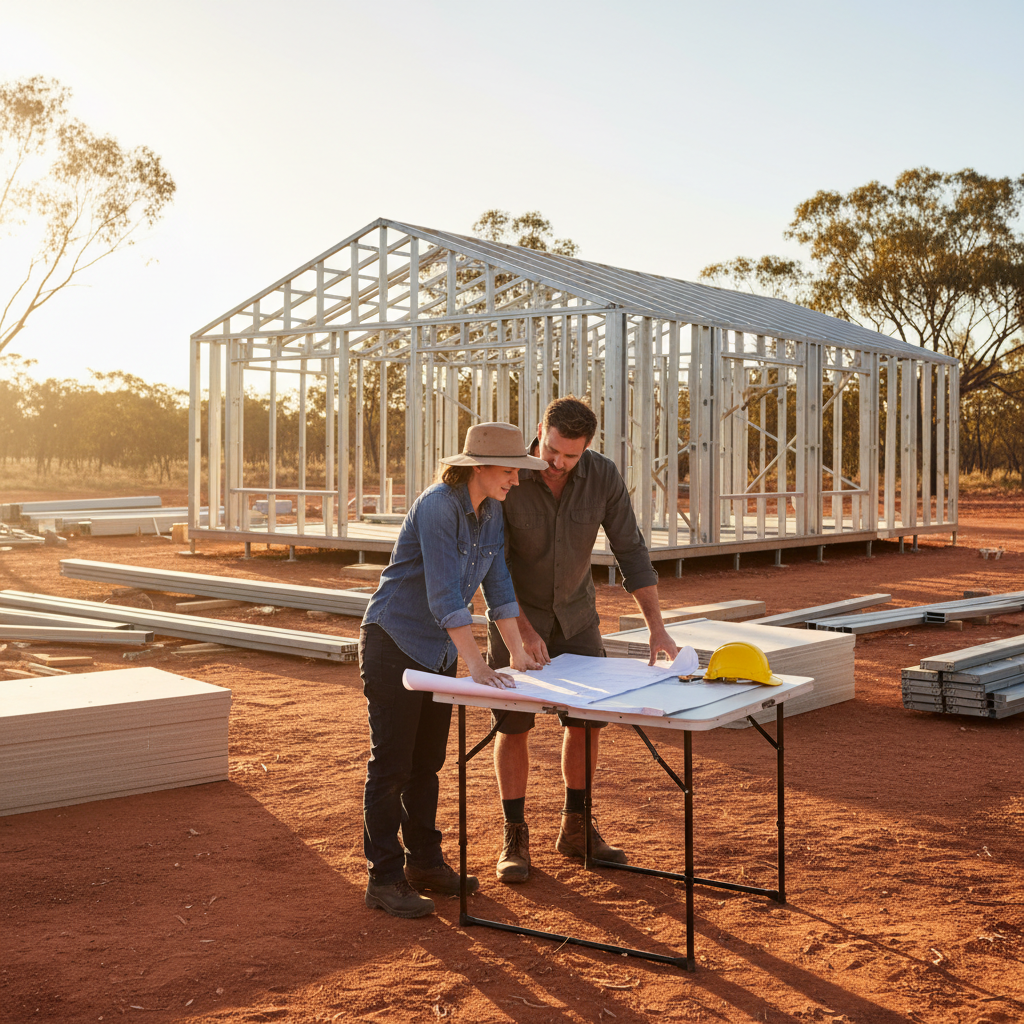
Choosing the plan is the fun part. Building it is where the grit happens. When you are assessing plans, look at the roofline. A simple hip and valley roof or a gable roof is much easier (and cheaper) to install than some complex multi-level flat roof system with internal gutters. Internal box gutters are the devil. They leak eventually. Always. Avoid them. Stick to external eaves where the water has somewhere to go if the gutters ever overflow in a Queensland downpour. Simple designs are faster to dry-in, which means you get your windows and doors in quicker and stop worrying about the weather ruining your subfloor.
You also need to think about your trades early. Plumbers hate it when the bathrooms are scattered all over the house. If you can back the laundry onto the kitchen, or put two bathrooms back-to-back, you will save thousands on copper pipe and drainage works. Every time a plumber has to run a line across the house, your bill goes up. Efficiency in the plan leads to efficiency in the build.
Final Thoughts on the Selection Process
Take your time. Print out the plan and stick it on your fridge for a month. Every time you go to make a coffee, imagine you are in that kitchen. Is the bin in a stupid spot? Is there enough bench space next to the oven to put down a hot tray? If the plan doesn't feel right after four weeks of staring at it, it is not the right plan. Don't let a salesperson talk you into a design because it is 'on sale' or popular. They don't have to live in it. You do. Trust your gut and focus on the flow. And for heaven's sake, make sure you have enough storage. You can never have too many wardrobes.